Fitting ToSeven
MidDrive Motors Across
Frames, Styles & Custom Builds
Converting standard bicycles, fat bikes, recumbents, cargo bikes, and trikes into high-performance electric vehicles using ToSeven DM01 and DM02 mid-drive motors requires a deep understanding of frame metallurgy, drivetrain geometry, battery chemistry, and electrical routing. Unlike hub motors, mid-drives route all electric assist directly through the bicycle’s mechanical drivetrain. Proper motor selection, frame evaluation, display integration, cable routing, battery placement, and anti-rotation stabilization are essential for a safe, reliable, and professional conversion.
1. System Overview: ToSeven Motor Platforms
- ToSeven DM02 Series (250W, 350W, 500W): A compact, lightweight (~3.6 kg to 3.9 kg) mid-drive system producing up to 90 N·m of peak torque. Available in 68–73 mm, 100 mm, and 110 mm bottom bracket (BB) widths. The DM02 is ideal for daily commuters, road bikes, folding bikes, hybrids, and light trail builds.
- ToSeven DM01 Series (750W, 1000W, 1200W): A heavy-duty power unit (~5.8 kg to 6.0 kg) engineered for demanding applications, delivering up to 160 N·m of peak torque. Available in 68–73 mm, 100–110 mm, and 120 mm BB widths. Built for heavy cargo hauling, tandems, fat bikes, extreme off-road climbing, and utility trikes.
- Bottom Bracket Shell Requirements: Both systems fit standard threaded BSA bottom bracket shells with an inner diameter of 33.6 mm to 34.0 mm. Maintain at least a 2 mm clearance gap between the motor housing and the frame tubes or chainstays.
2. Frame Metallurgy & Material Fitting Directives
Understanding frame materials and construction is critical before applying the high clamping forces and rotational torque of a mid-drive motor.
Steel Frames (Chromoly & Hi-Ten)
- Technician’s Verdict: Exceptional. Steel is the most resilient material for mid-drive retrofits. Its high tensile strength easily withstands motor rotational torque, and the anti-rotation bracket’s locking teeth bite securely into the BB shell face.
- Ashtabula (1-Piece Crank) Conversion: Traditional beach cruisers, vintage American bicycles, and old-school BMX frames often feature unthreaded 51.3 mm (2.02") Ashtabula bottom bracket shells. These require a press-fit BSA bottom bracket adapter to reduce the shell diameter down to standard 33.6–34.0 mm threaded BSA specifications.
- Locking Protocol: Applying threadlocking compound (e.g., Loctite 243) between the fitting washer/bracket and the steel BB shell face creates a permanent mechanical bond.
Aluminum / Alloy Frames
- Technician’s Verdict: Standard / Excellent. Aluminum is the most common frame material for modern e-bike conversions.
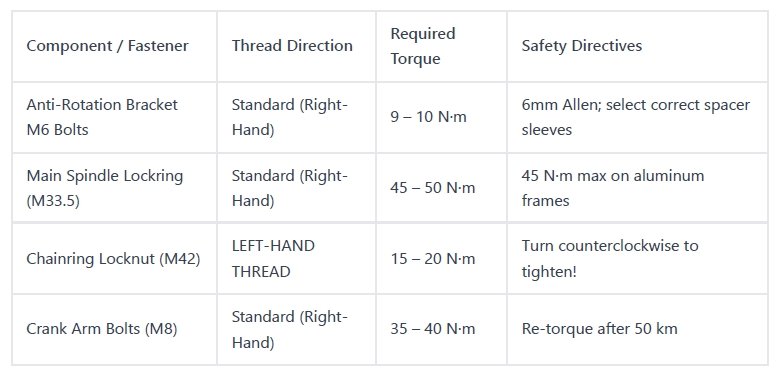
- Special Considerations: Aluminum is softer than steel. When torquing the M33.5 main lockring, stick to 45 N·m (the lower end of the 45–50 N·m specification) to prevent galling or crushing the aluminum BB face. Ensure BB threads are thoroughly cleaned of weld splatter or paint overspray before sliding the axle tube through.
Carbon Fiber Frames
- Technician’s Verdict: Strict Caution / Generally Not Recommended.
- Special Considerations: Mid-drive motors subject the bottom bracket shell to high clamping forces and up to 160 N·m of localized twisting torque. Standard carbon fiber layups are engineered for pedaling loads, not external clamping pressure. Installing a DM01 or DM02 on a standard carbon frame can cause catastrophic carbon delamination or frame failure. Only proceed if the bicycle manufacturer has explicitly certified the carbon frame for high-torque mid-drive retrofits.
3. Compatible Display Interfaces & Mounting Options

- T24 Color Display: Features a 2.4-inch color TFT screen mounted centrally over the stem via a dual-mount bracket, paired with a separate 4-button silicone handlebar remote. Supports 15V to 60V operation and includes a built-in diagnostic test screen.
- T154 & M15 Compact Displays: Compact 1.54-inch displays designed to clamp directly onto the left or right side of the handlebar next to the grip. The T154 features a full-color TFT screen, while the M15 uses a high-contrast monochrome LCD screen for sunlight readability. Both are IP65 water-resistant.
- LCD135C / LCD135CBT (Bluetooth): A large 3.5-inch color display mounted centrally over the stem. The Bluetooth variant (LCD135CBT, stamped with "BLE" on the back) pairs with an Android mobile app for custom OCV curves, navigation, and digital bike locking.
- Wiring Note: On the LCD135C, the thumb throttle plugs directly into a specialized "TH" socket on the back of the display housing rather than down at the main harness.
4. Battery Systems: Voltage, Capacity, Placement & Cost Dynamics
Choosing the correct battery requires balancing voltage ratings, energy capacity (Watt-hours), mounting geometry, and safety.
Voltage Tiers & Controller Ceilings
- 36V Systems: Suitable for budget-conscious urban commuters and DM02-250W/350W builds.
- 48V Systems: The industry sweet spot, offering optimal torque and efficiency for both DM02 (500W) and DM01 (750W/1000W) motors.
- 52V Systems: Supported on DM01 and DM02 motors, delivering higher top-end cadence and reduced voltage sag. Note: System voltage must be set to 52V in the display settings menu to ensure accurate battery capacity display and protection. A fully charged 52V pack reaches 58.8V, fitting safely under the display/controller 60V ceiling.
- 60V Battery Pause Warning: Sales and support for 60V battery configurations have been temporarily paused by the factory for both DM01 and DM02 systems. Factory testing confirmed that operating under 60V batteries (which reach ~67.2V at full charge) severely impacts controller MOSFET longevity.
Energy Capacity, Range & Cost
Battery capacity is measured in Watt-hours (Wh) (Nominal Voltage × Amp-hours):
- Urban / Commuting (360Wh – 500Wh / ~10Ah–13Ah): Delivers 25–45 km of range under moderate assist. Lower cost, lightweight.
- Long-Distance / Touring / Cargo (750Wh – 1000Wh+ / ~15Ah–20Ah+): Delivers 60–100+ km of range. Higher initial investment, but essential for heavy loads or steep terrain.
- Cell Quality Warning: Avoid unbranded, cheap battery packs. Quality batteries constructed with grade-A Samsung, LG, or Panasonic cells and a smart Bluetooth BMS provide thermal protection, stable current delivery, and prevent fire hazards.
Battery Mounting Locations
- Downtube Bottle Mounts (Frame Triangle): The primary location for standard diamond frames, keeping weight low and centered.
- Rear Rack Mount: Common on step-through, city, or folding bikes lacking triangle space. Requires a reinforced rack to prevent swaying.
- Triangle Frame Bag: Ideal for custom fat bikes or mountain bikes with non-standard frame geometry.
- Recumbent Frame / Under-Seat Mounts: Secures weight beneath the seat frame or along the main boom to maintain low center of gravity.
- Cargo Box / Front Boom: On front-loading cargo bikes (Bakfiets), batteries can be mounted securely inside the cargo box or along the lower frame rail.
5. Cable Harness Extensions & Long-Wheelbase Wiring
Standard e-bike wire harnesses are designed for standard bicycle frame dimensions. Long-wheelbase builds require specialized extensions:
- Recumbents: Placing the motor on a front boom far ahead of the handlebars requires a 1T4 EB-Bus main harness extension cable (or display extension) to bridge the distance to handlebar controls. Speed sensor extension cables are also required to reach the rear wheel.
- Cargo Bikes & Tandems: Longtail cargo bikes and tandem bicycles require extended speed sensor cables to reach the rear chainstay, as well as extended battery lead harnesses running from mid-frame to the motor.
- Routing Directives: Support long cable runs along frame tubes using protective spiral cable wrap and heavy-duty zip ties. Avoid running harnesses through tight pinch points near suspension linkages or steering hinges. Tuck excess wire loops neatly inside frame bags or protective PVC housing.
6. Motor Stabilization & Anti-Rotation Clamp Systems
When a mid-drive motor delivers torque to the chainring, an equal and opposite force attempts to rotate the motor housing downward around the bottom bracket shell. Multiple stabilization solutions are available:
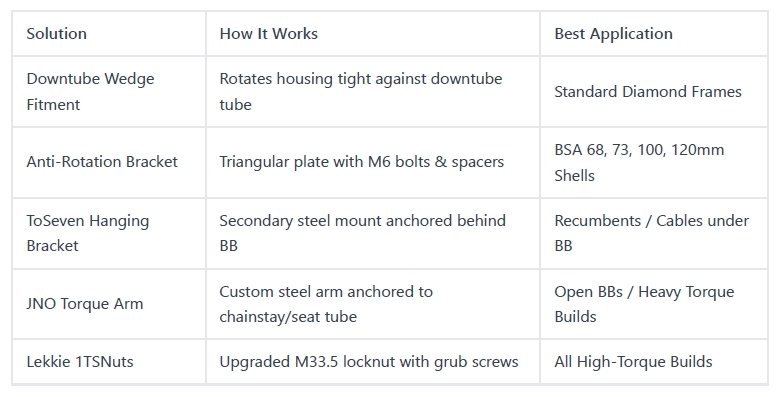
- Standard Downtube Wedge Fitment: On standard diamond frames, rotate the motor assembly upward during installation until the housing sits firmly against the underside of the downtube. Tightening the main lockring in this position prevents the motor from pivoting under load.
- Anti-Rotation Bracket: Included with ToSeven kits, this triangular plate fits against the non-drive side BB face. Select M6 mounting bolts and spacer sleeves matching your BB width (0 mm spacer for 68 mm, 5 mm for 73 mm, 32 mm for 100 mm, 42 mm for 110 mm, 52 mm for 120 mm) and torque bolts to 9–10 N·m.
- ToSeven Hanging Bracket: Designed for recumbents, front-boom trikes, or bikes where shift/brake cables are routed directly beneath the BB shell (preventing upward downtube contact). The hanging bracket mounts behind the BB shell to lock motor rotation independently. Tip: Always install a washer on the upper bracket mounting bolt to prevent hardware loosening.
- JNO Torque Arm / Custom Clamps: A heavy-duty steel torque arm (such as the JohnnyNerdOut torque arm) clamps around the chainstay or seat tube, anchoring the motor casing on open BB designs or extreme-torque builds.
- Lekkie 1TSNuts Upgrade: Replacing the standard multi-notch main lockring with a precision-machined Lekkie 1TSNuts (M33.5 thread) allows mechanics to use a standard Shimano bottom bracket socket tool to apply exact torque (45–50 N·m). Integrated grub screws lock the nut in place.
7. Comprehensive Fitment Directives Across 14 Bike & Trike Styles
1. Mountain Bike (MTB & Hardtail / Full-Suspension)
- Recommended Motor: DM02 (500W) or DM01 (750W/1000W).
- Fitment Strategy: Rotate motor housing tight against the downtube. Use a 42T (DM02) or 46T (DM01) dished 9mm offset chainring to achieve a clean 50 mm chainline across wide 8-to-12-speed rear cassettes. Use a clutch-equipped rear derailleur to eliminate chain bounce over rough trails.
2. Tandem Bike
- Recommended Motor: DM01 (1000W / 160 N·m torque).
- Fitment Strategy: Tandems carry two riders and heavy total payloads, making the high torque of the DM01 mandatory. Install the motor in the rear (stoker) bottom bracket shell so the captain-to-stoker timing chain remains uninterrupted on the left side, while the motor drives the primary rear cassette on the right.
3. Recumbent (Two-Wheel Bicycles & Low-Rider Trikes)
- Recommended Motor: DM02 or DM01 depending on speed and terrain goals.
- Fitment Strategy: Recumbents locate the BB at the front of a boom tube. Because there is no downtube above the BB to rest the motor against, upward wedging is impossible. Install the ToSeven Hanging Bracket or a JNO Torque Arm anchored to the boom. Use 1T4 harness extension cables for handlebar controls and route long chain runs through clean idler pulleys.
4. BMX Bike
- Recommended Motor: DM02 (250W / 350W / 500W).
- Fitment Strategy: BMX bikes feature compact frame triangles and short chainstays. The compact DM02 (~3.6 kg) provides a high power-to-weight ratio without overwhelming the frame. Older BMX bikes with unthreaded 51.3 mm Ashtabula bottom brackets require a BSA conversion adapter. Ensure single-speed rear cog alignment is straight.
5. Upright Trike (Adult Utility Tricycles)
- Recommended Motor: DM01 or DM02.
- Fitment Strategy: Built for stability and cargo hauling. Because trike frames often feature open BB areas or low step-through designs, install a torque arm or hanging bracket to lock the motor housing securely. The motor assists the central jackshaft or rear differential.
6. Fat Bike
- Recommended Motor: DM01-1000L/T (100mm, 110mm, 120mm BB) or DM02L (100mm, 110mm BB).
- Fitment Strategy: Fat bikes feature wide chainstays to clear 4.0"–5.0" tires. Measure BB shell width accurately and select the corresponding wide axle motor. Use specified mounting bracket spacer sleeves (32 mm to 52 mm) so the plate sits completely flush. Configure tire circumference accurately in display settings.
7. Cargo Bike (Longtail & Front-Loader / Bakfiets)
- Recommended Motor: DM01 (1000W / 160 N·m torque).
- Fitment Strategy: Heavy commercial delivery and cargo hauling require maximum low-end torque. Cargo frames often route shift/brake cables directly under the BB shell. Reroute cables using full outer housings above the BB shell, or install the ToSeven Hanging Bracket to prevent cable pinching.
8. Commuter Bike
- Recommended Motor: DM02 (250W / 500W).
- Fitment Strategy: Ideal for urban pavement and street-legal compliance (EN15194 250W or US Class 1/3). Connect a gear shift sensor to the yellow female Julet connector on the harness to cut motor power during gear changes, protecting your chain and cassette cogs. Connect headlights and taillights to the green 5-pin light port.
9. Hybrid Bike
- Recommended Motor: DM02 (350W / 500W) or DM01 (750W).
- Fitment Strategy: Hybrids typically feature standard 68–73 mm BSA bottom bracket shells and generous frame clearances, making them straightforward conversions. The integrated Wheatstone bridge torque sensor provides a smooth, natural pedaling response across both paved roads and light gravel paths.
10. Road Bike
- Recommended Motor: DM02 (250W / 350W).
- Fitment Strategy: Road conversions prioritize low weight and sleek integration. Multiple front chainrings are replaced by a single 42T dished 9mm offset chainring to maintain a 50 mm chainline across narrow 10-to-12-speed road cassettes.
11. Gravel Bike
- Recommended Motor: DM02 (350W / 500W).
- Fitment Strategy: Gravel riding demands smooth power modulation over loose terrain. The DM02's torque and cadence sensors adjust assist instantly based on pedal effort. Pair with a 110BCD narrow-wide offset chainring to keep the chain locked on over bumpy unpaved roads.
12. Touring Bike
- Recommended Motor: DM01 (750W) or DM02 (500W).
- Fitment Strategy: Long-distance touring involves heavy panniers and sustained riding. Pair with high-capacity 48V or 52V battery packs. If using an Internal Gear Hub (IGH) like a Rohloff 14-speed or Shimano Nexus/Alfine, calibrate virtual chainring and cassette teeth parameters in display settings for accurate speed tracking.
13. Folding Bike (16", 20", 24" Wheels)
- Recommended Motor: DM02 (250W / 350W).
- Fitment Strategy: Folding bikes feature tight clearances and unique frame hinges. The compact size of the DM02 avoids interfering with the folding mechanism. Bundle harness wiring neatly using spiral wrap to prevent cables from snagging when the frame is collapsed.
14. Cruiser Bike (Beach Cruiser)
- Recommended Motor: DM02 (350W / 500W) or DM01 (750W).
- Fitment Strategy: Cruisers can feature relaxed geometry and wide BB areas. Traditional 1-piece Ashtabula cranks require a BSA threaded adapter. If using a rear coaster (pedal kickback) brake, install magnetic e-brake cutoff sensors on aftermarket handlebar brake levers to ensure safe motor disengagement, as the coaster brake will no longer function (Cranks freewheel backwards).
8. Master Fastener Torque & Safety Summary
Always use a calibrated torque wrench and medium-strength threadlocker (Loctite 243) during assembly.
Critical Operating Directives
- Unloaded Startup Calibration Rule: Every time the display turns on, the controller measures resting torque sensor voltage to calibrate its zero point. Never rest your feet or place weight on the pedals when turning on the e-bike. Applying pedal pressure during boot-up corrupts the 0.6V–0.7V baseline reference, causing assist lag or complete loss of assist.
- IP65 Water Resistance & Washing Rules: ToSeven drive systems carry an IP65 water protection rating (dust and low-pressure spray resistant). Never use high-pressure washers or direct hose streams on the motor housing, display, or wire plugs—high pressure forces water past rubber shaft seals and connector gaskets.